Pearson Edexcel · A-Level · Mathematics
Course version: 9MA0 · Version from Mar 2026
Solve simultaneous equations in two variables by elimination and by…
Full specification wording
Algebra and functions: 2.4 Solve simultaneous equations in two variables by elimination and by substitution, including one linear and one quadratic equation.
Simultaneous equations in two variables are solved by finding every pair (x, y) that satisfies both equations at once.
Checked against the Pearson Edexcel 9MA0 specification (opens in a new tab) on .
- Point 4 of 11
Study notes
From the checked teaching notes for this specification point.
The idea
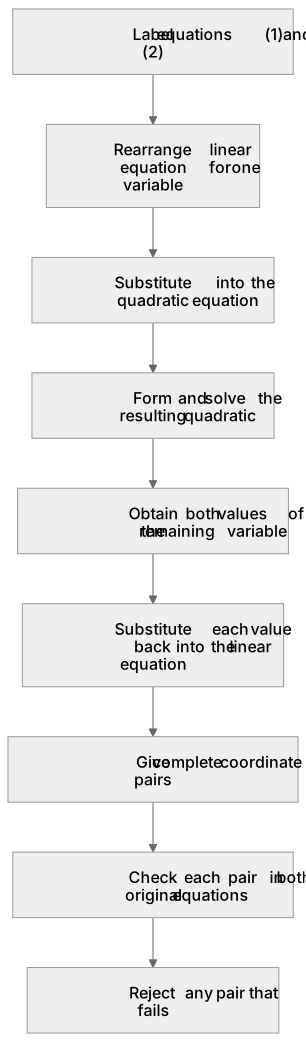
Simultaneous equations in two variables are solved by finding every pair (x, y) that satisfies both equations at once. Elimination adds or subtracts multiples of the equations to remove one variable; it suits two linear equations, where the result is normally a single pair. Substitution rearranges one equation for one variable and puts that expression into the other; it is the reliable method when one equation is linear and the other is quadratic, because it produces a quadratic in one variable with up to two solutions. Each solution must be a matching pair: substitute each value back to find its partner value, and check both pairs in both original equations. Graphically the solutions are the intersection points of a line and a curve.
What earns the marks
- Rearranges the linear equation to express one variable in terms of the other, for example y = 3x − 2, before substituting into the quadratic equation.
- Forms and solves the resulting quadratic correctly, obtaining both values of the remaining variable.
- Pairs each value with its partner by substituting back into the linear equation, giving complete coordinate pairs.
- Uses elimination accurately for two linear equations, scaling one or both equations so that a variable has equal coefficients before adding or subtracting.
- Checks each pair in both original equations and rejects any pair that fails.
Common mistakes and how to put them right
Substituting into the same equation that was rearranged, which returns a trivial identity.
Put it right by substituting into the other equation.
Giving only one solution when the quadratic factorises into two distinct roots.
Put it right by solving fully and pairing both values.
Mixing values from different solutions, such as pairing the first x with the second y.
Put it right by substituting each x separately into the linear equation.
Exam tips
- Label the equations (1) and (2) and show each substitution step so the method is easy to follow.
- For a line and a curve, expect up to two intersection points and state both coordinate pairs.
- Finish by substituting each pair into the equation not used for the substitution, as a quick check.
Try the lesson
The start of the Algebra and functions: 2.4 Solve simultaneous equations in two variables by elimination and by substitution, including one linear and one quadratic equation. lesson, made from checked teaching notes for this specification point.
Have a go first
Solve the simultaneous equations y = x² − 4x + 5 and y = x + 1.
Listen
Simultaneous equations in two variables are solved by finding every pair (x, y) that satisfies both equations at once. Elimination adds or subtracts multiples of the equations to remove one variable; it suits two linear equations, where the result is normally a single pair. Substitution rearranges one equation for one variable and puts that expression into the other; it is the reliable method when one equation is linear and the other is quadratic, because it produces a quadratic in one variable with up to two solutions. Each solution must be a matching pair: substitute each value back to find its partner value, and check both pairs in both original equations. Graphically the solutions are the intersection points of a line and a curve. A strong answer earns marks for these points. Rearranges the linear equation to express one variable in terms of the other, for example y = 3x − 2, before substituting into the quadratic equation. Forms and solves the resulting quadratic correctly, obtaining both values of the remaining variable. Pairs each value with its partner by substituting back into the linear equation, giving complete coordinate pairs. Uses elimination accurately for two linear equations, scaling one or both equations so that a variable has equal coefficients before adding or subtracting. A common slip: Substituting into the same equation that was rearranged, which returns a trivial identity. Instead, substituting into the other equation. Exam tip: Label the equations (1) and (2) and show each substitution step so the method is easy to follow.
See it
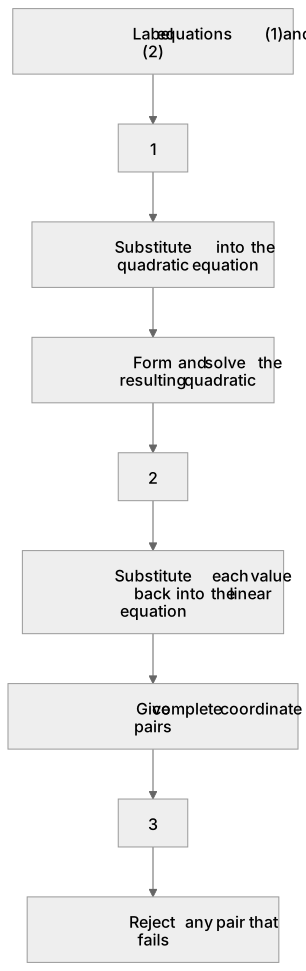
Label the diagram
Some boxes have lost their names. Pick the right name for each number.
1Box 1
2Box 2
3Box 3
There is more to this lesson
The full lesson goes on to check your understanding and help you earn the marks. Create a free account to carry on, with your progress saved.
A week of Premium from your first lesson · Then the free plan continues · No card, no charge
Test your understanding of Algebra and functions: 2.4 Solve simultaneous equations in two variables by elimination and by substitution, including one linear and one quadratic equation.
Active recall beats re-reading. Take an instant quiz now to test what you’ve learned and lock it into long-term memory.
A week of Premium from your first lesson · Then the free plan continues · No card, no charge